In the 1990s, the term "vintage" was used to describe vintage clothing that did not meet the definition of "antique," but still had value, as opposed to "antique" clothing that was 100 years old. Nowadays, there is a movement to find new value in "new vintage," even in old clothes from the 1980s onward, which used to be called "regular" vintage clothes. In this project, four vintage clothing stores with different styles propose new ways to enjoy vintage clothing. Each of them will talk about the charm of vintage clothing with their own sense of style.
Before we knew it, this series has entered its 18th season, and we’re bringing you this installment from a new shop. For our 138th installment, we’re visiting “comp,” located in front of Shoin Shrine in Setagaya Ward, Tokyo—an area that has, before we knew it, become a hotbed of vintage clothing stores. What kind of “new vintage” finds will the owner, Mr. Ishikawa, introduce to us!?
Text_Tommy
Edit_Yosuke Ishii
Daiki Ishikawa / Owner of comp
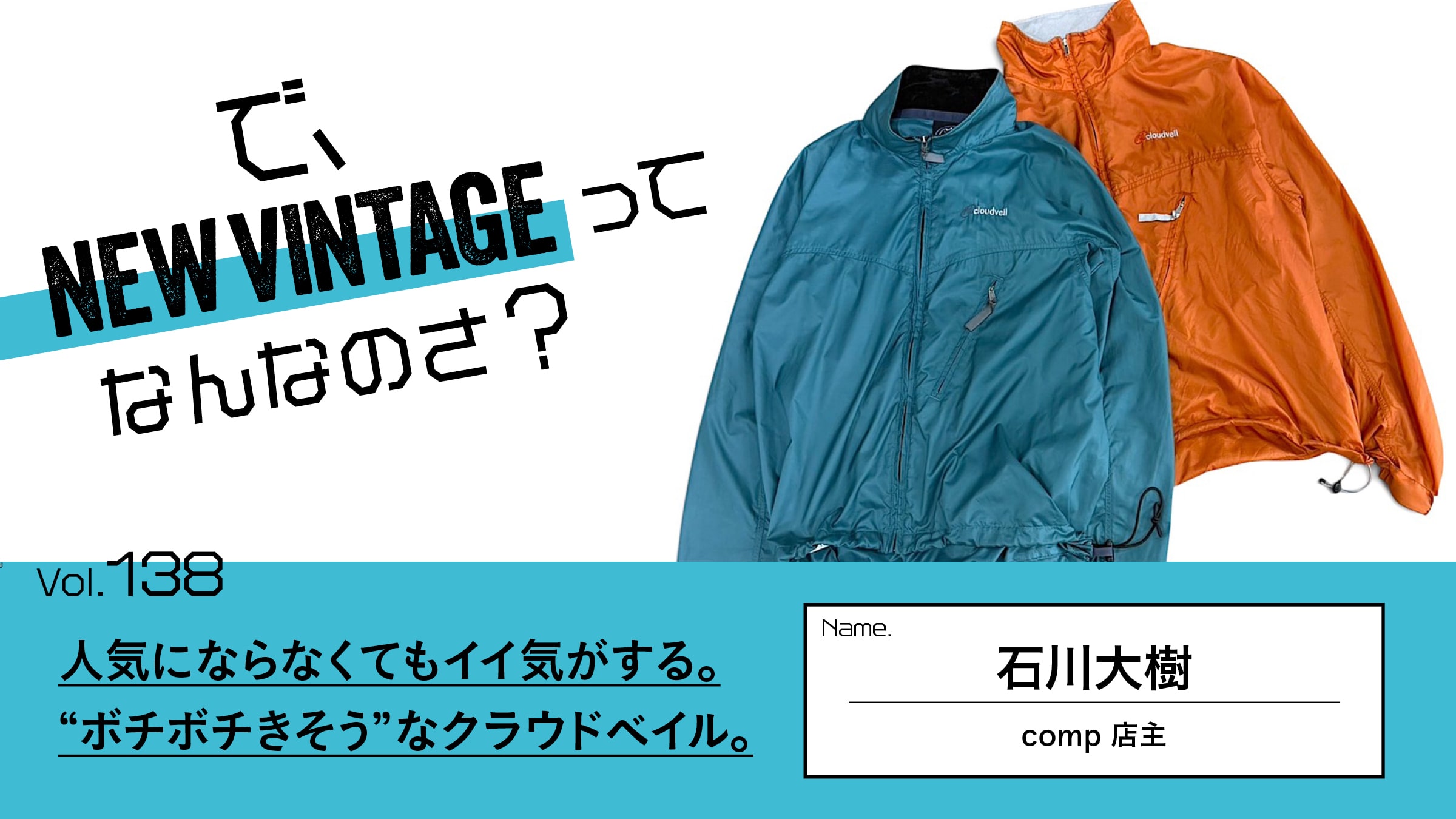
Vol. 138_Cloudvale Nylon Shell Jacket
—The theme of this series is “finding good staples now that will be remembered and recorded just like true vintage items.” What is Mr. Ishikawa’s definition of “new vintage”?
That’s right. I guess you could say it’s “something that has the potential to be appreciated by many people based on a single spark.” I didn’t start out in the vintage clothing business, and I’ve had plenty of opportunities to come across current-season items. There are quite a few cases where vintage pieces that served as inspiration for current-season items end up becoming popular, aren’t there? I think that’s because brand designers are drawing inspiration from them based on the idea that “it would be interesting to wear this now,” so I suppose there’s a natural possibility that those pieces could become “new vintage.”
—Do you think we can find any commonalities there?
While this is a different perspective from that of true vintage or art pieces, I think there’s some truth to the idea that “rather than rarity, mass production creates a foundation that makes these items more accessible to a wider audience and easier to appreciate.” It’s simply a matter of supply and demand, but I think the value will continue to rise as demand grows not only from so-called vintage enthusiasts but also from beginners.
—I see. So, what are these “new vintage” items you’re introducing this time?
Since this is the first round, I’ve started by preparing a jacket featuring *Cloudvell* to make things easy to understand.
To reach even beginners, the brand’s background is also a factor in its appeal. For example, “a brand founded by [Name], formerly of [Company].” This brand also has a story—its designer is a former [Patagonia] employee—and given [Patagonia]’s popularity in recent years, it’s likely to gain popularity in the future.

Cloudvale Nylon Shell Jacket: 12,100 yen(Comp)
Cloudvale Nylon Shell Jacket: 12,100 yen(Comp)
—There are a few shops here and there that I’ve been keeping an eye on as “good regulars,” right? Could you tell me a little more about what kind of brands they are?
Cloudvale was founded in Jackson Hole, Wyoming, in 1997. It was founded by Stephen Sullivan, who had ties to 〈Patagonia〉, and his partner Brian Cousins. Initially, the brand reportedly provided functional and stylish apparel to local hardcore backcountry skiers and climbers.
—I remember seeing them on the shelves at outdoor stores and boutique shops in Japan back then.
The brand is also known as a “pioneer of softshell,” having been one of the first to adopt softshell—a material with excellent breathability and stretch—as its main fabric. Since the concept of softshell was still relatively rare at the time, it seems to have been popular among trendsetters with a keen eye for the latest styles. However, following its acquisition by a major sports group in the mid-2000s, the brand effectively ceased to exist in 2010. This item dates from the early 2000s and is a nylon shell jacket with a stand-up collar. Although it’s made in China, I honestly don’t think “Made in the USA” is the be-all and end-all.
What do you mean by that?
If anything, when I’m buying items, I pay close attention to whether the tag says “Jackson Hole.” I think this varies depending on the year of manufacture, but I feel like the quality also differs depending on whether or not this text is present.
—That's something to keep in mind.
Another strong point is the thin, lightweight nylon ripstop fabric. While items of this type are often half-zip pullovers, the full-zip design offers more options for layering and allows you to vary the silhouette depending on how you style the zipper. Also worth noting is the diagonal chest zipper, a detail also seen in Patagonia items from the same period. Designed for easy opening and closing, this piece—with its yoke seam for enhanced mobility and a drawcord at the hem to keep out rain and wind—is simple and understated yet packed with well-thought-out functional beauty.
—Is this type of lightweight outerwear a staple item?
We often get new shipments of *Cloudvale* itself, and I feel like it’s gradually gaining recognition here at our store, but even then, most of it is softshell. Nylon shells like this one might actually be surprisingly rare. To begin with, when it comes to outdoor gear, I’m the type who thinks newer is better. That’s because, if the premise is incorporating items into your wardrobe rather than collecting them, “whether or not you can actually wear them” is what matters. Since synthetic fabrics carry the risk of the lining deteriorating over time, that’s why I recommend items from the 2000s in this category.
—Both have really nice colors.
Most of our customers aren’t hardcore outdoor enthusiasts who actually use these items for outdoor activities, nor are they die-hard fans of the genre; rather, they’re people who simply want to incorporate vintage pieces as a fashion statement. That’s exactly why I think they’re drawn to the worn-in look and slightly retro-chic colors that you just don’t find in today’s mainstream outdoor wear. I personally advocate for “enjoying vintage clothing by going with your gut rather than getting bogged down in the details,” and I think it’s perfectly fine to just choose pieces based on whether they fit you well.
—If we’re thinking in terms of “whether we can reach beginners,” as we mentioned earlier, that’s certainly true. The key is “how we can adapt.”
Then there’s the price. Even if you find a great item, I think you’ll end up thinking, “I’d want it if it were cheap, but if it’s expensive, I’ll just go with something else.” Take *Cloudvale*, for example. In that regard, I’d say it’s a perfect fit for *Comp*—which is themed around “cheap chic”—in the sense that you can “enjoy it casually without worrying about trends or price.” However, as it gains popularity, the prices will naturally go up, so I’m actually hoping it stays just the way it is… (laughs)
Daiki Ishikawa / Owner of comp
The owner of “Comp,” which opened in June 2025 near the entrance to the shopping district in front of Shoin Shrine in Setagaya Ward, Tokyo—an area that has become a hotbed of competition among vintage clothing stores. Based on the concept of “cheap chic,” the store offers vintage clothing that visitors can enjoy casually, without worrying about trends or prices. As customers discover clothes that truly fit them, this newcomer shop is drawing attention from vintage beginners to industry insiders alike.
Instagram:@comp_used_clothing


![[Series 【: What the Heck Is “NEW VINTAGE”?] Vol. 143 Wait, Lee is “Europe’s Oldest Denim Manufacturer”!? No, that’s not right—it’s Lee Cooper, not Lee.](https://www.houyhnhnm.jp/wp-content/uploads/2026/10/nv_143a-700x394.jpg)
![[Series: 【—What Exactly Is “NEW VINTAGE”?] Vol. 142 “It’s Just So Awesome” Chico’s Design. That all-over embroidered denim jacket is just so cool, isn’t it?](https://www.houyhnhnm.jp/wp-content/uploads/2026/09/nv_142b-700x394.jpg)
![[Series 【: What Exactly Is “NEW VINTAGE”?] Vol. 141 “What’s Next After Rasler!?” What Is “Texas Stretch” from the 2000s?](https://www.houyhnhnm.jp/wp-content/uploads/2026/09/nv_141b-1-700x394.jpg)
![[Series 【: What Exactly Is “NEW VINTAGE”?] Vol. 140: Lowering the Bar by “Expanding the Subject.” Sound Clips You Can Choose Based on Mood and Graphics.](https://www.houyhnhnm.jp/wp-content/uploads/2026/08/nv_140a-700x394.jpg)
![[Series: 【—What Exactly Is “NEW VINTAGE”?] Vol. 139: Is “Instagrammability” Also a Requirement for New Vintage? Keep That in Mind for Week Closing.](https://www.houyhnhnm.jp/wp-content/uploads/2026/08/nv_139a-700x394.jpg)
![[Series 【: What Exactly Is “NEW VINTAGE”?] Vol. 137 “Can You Wear Them Like Sneakers!?” Western Boots to Try Right Now.](https://www.houyhnhnm.jp/wp-content/uploads/2026/07/nv_137a-700x394.jpg)