In the 1990s, the term "vintage" was used to describe vintage clothing that did not meet the definition of "antique," but still had value, as opposed to "antique" clothing that was 100 years old. Nowadays, there is a movement to find new value in "new vintage," even in old clothes from the 1980s onward, which used to be called "regular" vintage clothes. In this project, four vintage clothing stores with different styles propose new ways to enjoy vintage clothing. Each of them will talk about the charm of vintage clothing with their own sense of style.
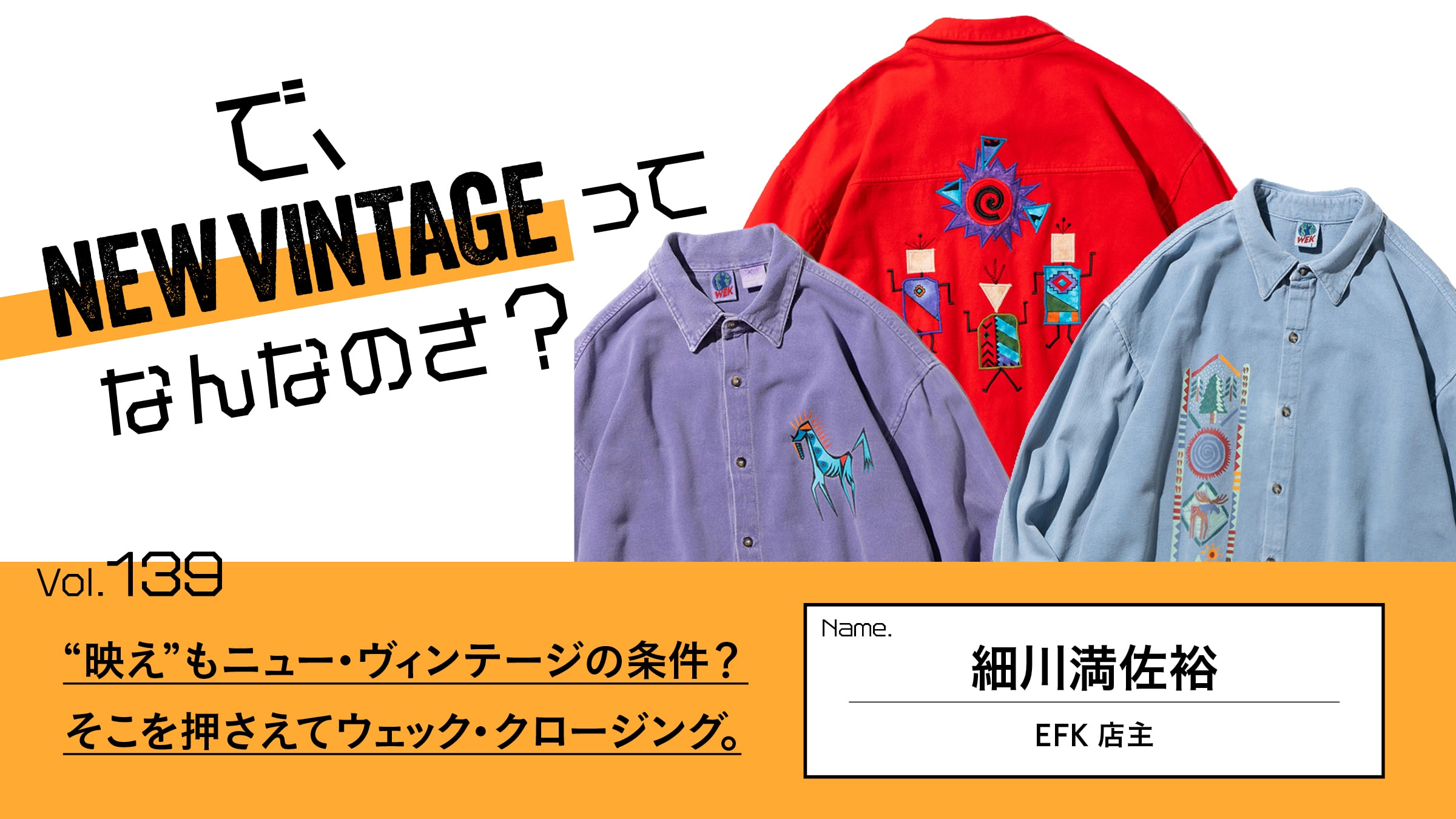
Before we knew it, this series has entered its 18th season, and we’re bringing it to you from a new shop. For the 139th installment, we’re featuring “EFK” in Ikejiri-Ohashi, a shop beloved by fashion industry insiders. What kind of new vintage finds will the owner, Mr. Hosokawa, introduce to us!?
Text_Tommy
Edit_Yosuke Ishii
Mitsuhiro Hosokawa / Owner of EFK
Vol. 139_Weck Closing Shirts
—The theme of this series is “finding good staples now that will be remembered and recorded just like ”true vintage’ items.” What is Mr. Hosokawa’s definition of “new vintage”?
Given that the definition of “new vintage” itself varies from person to person, as someone from the generation that bought vintage clothing during the first vintage boom of the 1990s, I have this image of it as “items made before the 1960s that aren’t mass-produced, but rather are rare finds.” However, if we apply the term “vintage” to the “new” (i.e., contemporary) era with that mindset, it’s hard to avoid mass-produced items, so perhaps it simply comes down to “niche items that haven’t received much attention yet but have a certain charm.”
—Does that include the items sold at “Ifuku”?
Personally, ever since the first vintage boom of the 1990s—when I used to enjoy wearing vintage clothing from the 1970s and ’80s, which was still considered “regular” back then—I’ve mainly focused on what I call “good regulars”: items from the ’90s onward that are relatively affordable and easy for vintage beginners to enjoy, rather than so-called “true vintage.”
—I’d like to take a look right away at the new vintage you’re introducing today.
As I mentioned earlier, since I want to target a niche market, for this first round I’d like to feature a shirt from *WEK CLOTHING*.
—I see. So, what is “Weck Closing”?
That makes sense, doesn't it? (laughs). I didn’t know the background of this item either—I just thought, “This has a nice vibe,” so I bought it, and only later found out that it’s from a separate line of a long-established apparel brand called *KELL SPORT*, which has been committed to American-made products since the 1970s and has continued to produce thick, high-quality heavyweight sweatshirts and the like. By the way, the brand is still in business today.
—Oh, really?
While *Kelsports* has the feel of an authentic blank-body manufacturer, this brand seems to have been aimed at younger consumers; it currently offers only a limited selection of its most popular models. So, the item I’m introducing today is a shirt-style piece called the “Big Easy.”

Weck Clothing Shirt: 9,790 yen(Ifuku)
Weck Clothing Shirt: 9,790 yen(Ifuku)
Weck Clothing Shirt: 9,790 yen(Ifuku)
—As the model name suggests, the silhouette seems to be on the larger side.
That’s right. It’s really roomy across the chest, and the set-in sleeves are set farther out, giving it a dropped-shoulder look, plus the armholes are pretty wide. It has a slightly oversized, boxy silhouette, and the style reflects the 90s—when the trend shifted from tucking in shirts to leaving them untucked—so you could call it a shirt jacket that’s almost like a coverall. Plus, the silhouette looks absolutely adorable when you wear it, so I highly recommend it.
—What is the body made of?
All the fabrics are cotton twill, with a slightly brushed, soft, and fluffy feel on the inside. The purple and blue versions are dyed all the way down to the tags, so you can tell they’ve been piece-dyed. Perhaps that’s why they feel a bit softer than the red one. True to their “Easy” name, the key features are their comfortable feel against the skin and ease of wear—and as noted on the tags, they’re all “MADE IN USA.” It seems they also carry other items, such as collared pullover sweatshirts.
—They all have embroidery or prints on them. Is this part of some kind of collaboration or something?
It’s actually a solid-color piece, but—I’m not sure if it’s a special order from a brand or an artist, or just a customization—it features a unique, primitive, ethnic-inspired design. In terms of the motifs and style, it feels more like Native American art from North America than African art. It might be part of a series inspired by a specific tribe, but to be honest, I don’t know the details (wry smile).
Also, personally, I think that “color schemes, designs, and silhouettes that look good on social media” might be one of the conditions for something to endure as “new vintage.”
What do you mean by that?
Looking good in photos is really important—it affects how easily your posts get noticed. Given the current trend of valuing a faded look, texture is especially important. In that regard, this piece not only features artwork brimming with originality but also combines color schemes, textures, silhouettes, and an overall vibe that perfectly aligns with the current aesthetic—all while making a strong statement. That means you can create a whole look with just this one piece. When searching for what I consider “New Vintage”—“niche items that haven’t quite seen the light of day yet but have a certain charm”—it’s worth keeping that in mind.
—That’s a new perspective we haven’t seen before. After reading this article, some of you might be thinking, “I feel like I’ve seen that somewhere before—maybe I’ll give it a try!” So, what’s the actual encounter rate like?
As I mentioned earlier, while there is an official e-commerce site, I think these are actually quite rare in the vintage clothing market. Since *Kelsports* uses the 90s “Black Dog” print on the body, I imagine quite a few people are familiar with it, but this particular piece is even more obscure. So, it’s possible that it didn’t sell very well back then, which naturally means there are few pieces circulating on the market. To be honest, I don’t really know much about this item either… (wry smile)
—Come to think of it, I kind of get the feeling this might be a souvenir. It has the kind of vibe you’d find at a shop selling traditional local goods.
That's true. So, if anyone out there has dug deeper into “Weck Clothing” than I have, please let me know! I'm looking for info (lol).
Mitsuhiro Hosokawa / Owner of EFK
Born in 1979 in Osaka Prefecture. He developed an interest in clothing from an early age, immersed himself in fashion throughout his childhood and teenage years, and later moved to Tokyo. After a series of twists and turns, he opened his own shop, “EFK,” in November 2020, located near Ikejiri-Ohashi Station on the Tokyu Den-en-toshi Line. The shop features a selection of items with “that certain something,” focusing primarily on vintage clothing from the ’90s and beyond.
Instagram:@EFK.official


![[Series: 【—What Exactly Is “NEW VINTAGE”?] Vol. 142 “It’s Just So Awesome” Chico’s Design. That all-over embroidered denim jacket is just so cool, isn’t it?](https://www.houyhnhnm.jp/wp-content/uploads/2026/09/nv_142b-700x394.jpg)
![[Series 【: What Exactly Is “NEW VINTAGE”?] Vol. 141 “What’s Next After Rasler!?” What Is “Texas Stretch” from the 2000s?](https://www.houyhnhnm.jp/wp-content/uploads/2026/09/nv_141b-1-700x394.jpg)
![[Series 【: What Exactly Is “NEW VINTAGE”?] Vol. 140: Lowering the Bar by “Expanding the Subject.” Sound Clips You Can Choose Based on Mood and Graphics.](https://www.houyhnhnm.jp/wp-content/uploads/2026/08/nv_140a-700x394.jpg)
![[Series 【: What the Heck Is “NEW VINTAGE”?] Vol. 138: I Don’t Think It Needs to Be Popular. Cloudvale, Which “Seems Like It Might Take Off.”](https://www.houyhnhnm.jp/wp-content/uploads/2026/07/nv_138a-1-700x394.jpg)
![[Series 【: What Exactly Is “NEW VINTAGE”?] Vol. 137 “Can You Wear Them Like Sneakers!?” Western Boots to Try Right Now.](https://www.houyhnhnm.jp/wp-content/uploads/2026/07/nv_137a-700x394.jpg)
![[Series 【: What Exactly Is “NEW VINTAGE”?] Vol. 136: Daydreaming About Landscapes Yet to Be Seen. Get in the Travel Mood with Local-Themed T-Shirts.](https://www.houyhnhnm.jp/wp-content/uploads/2026/06/nv_136b-700x394.jpg)