-about FUJICOLOR ARTBOOK-
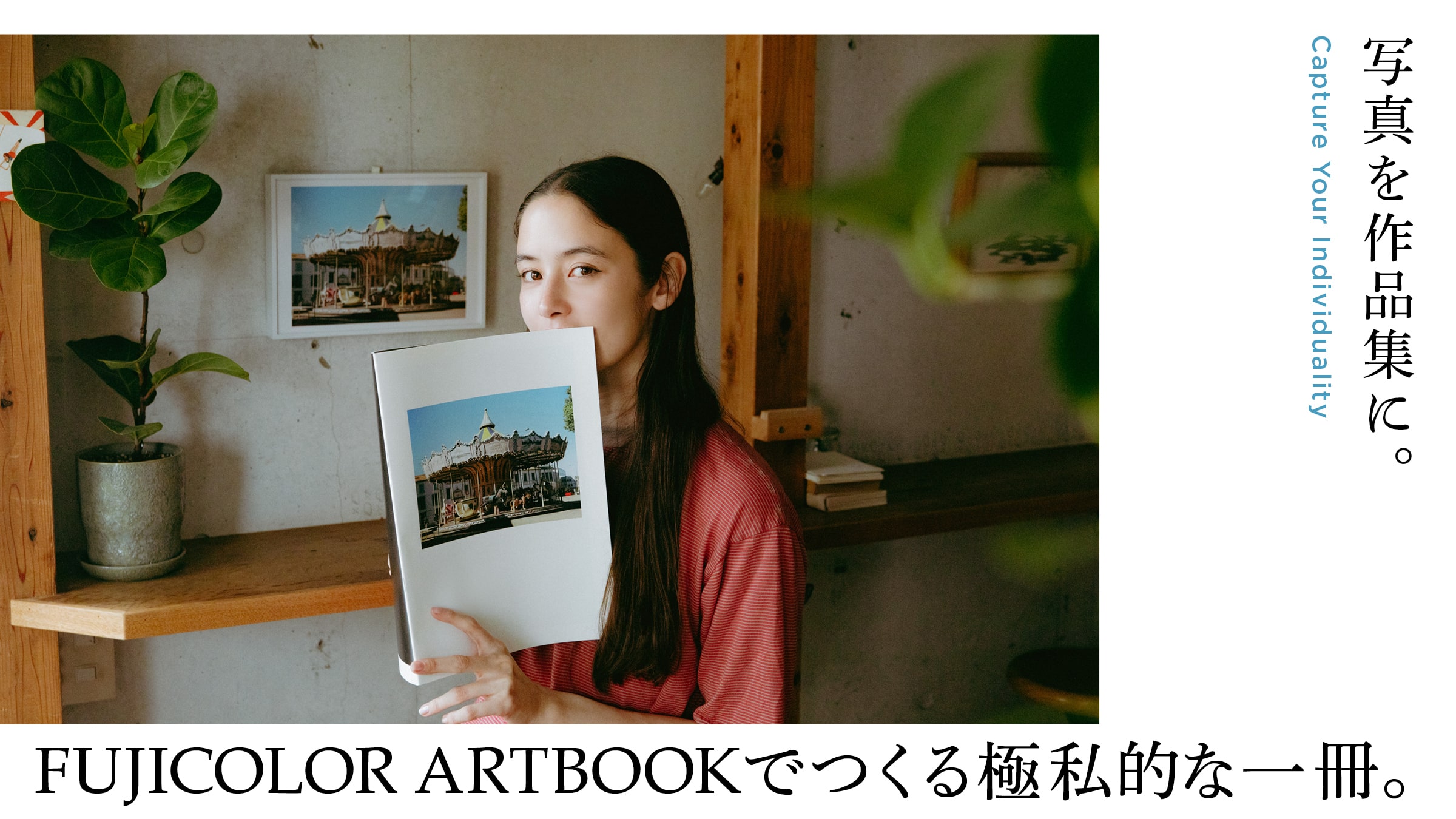
FUJICOLOR ARTBOOK, provided by FUJIFILM Corporation, is a service to create an original art book of professional-quality photographs. The paper is larger than A4 size (318mm x 236mm) with excellent color reproduction. The paper is larger than A4 paper (318mm x 236mm) and allows dynamic layouts, such as full spreads and borderless layouts. The service supports two types of ordering methods: web-based editing with automatic selection and layout support by a dedicated AI, and PDF.

-
luka
-
Shingo Kureya
-
Keiji Kaneko
case03_luka The memory of a journey, as a story in a book.
PROFILE
As a photographer luka and also as a model Ryuka, she is active in various media such as advertisements and magazines. With a deep attachment to film cameras, she energetically conducts photo shoots and photo exhibitions on her travels. In addition to her exhibition activities in Japan, her activities include fashion shoots and collaborations centered on photography.
What kind of camera do you usually use?
LUKA: Recently, I have been shooting digitally for some jobs, but basically, I tend to shoot with film cameras. I use four or five different cameras, and I also have a Fujifilm GA645 medium format camera, which I used to take the photos in this art book.
What is the reason for sticking to film?
LUKA: Digital images are delicate and beautiful in digital format, but with film, I feel that the film-like quality comes out naturally, without worrying so much about resolution. When I want to make a very large print, I choose one taken with a medium-format camera, and so on.
I see that you used some of Phil's photographs in the "FUJICOLOR ARTBOOK" this time.
LUKA: Last summer, I traveled for two months. I toured Los Angeles and New York in the U.S., and then crossed over to Europe, roadtripping by car to various countries. In Italy, I happened to watch a traditional horse race called "Palio," which still leaves quite an impression on me. I have put together a record of these trips, mixed with photos I took for the exhibition in Tokyo.
How did you decide on the theme?
LUKA: Without thinking too much about the details, I was thinking that it would be nice to start with a kind of morning glow and end with a sad or night-like feeling. I had a rough idea of how I wanted the pages to look, but I didn't think too much about the rest. The locations where the photos were taken were all different, but I thought that would be interesting.
The photo on the cover is a merry-go-round.
LUKA: This is a merry-go-round taken in Arles, France, where Van Gogh is said to have spent his final days. It is my favorite photo, so I used it as a starting point and was able to decide on the rest rather easily.
If the size changes, the negative becomes a positive.
Did you decide on the layout yourself?
LUKA: I was also interested in AI's layout support, but this time I did not use it and put it together myself. However, I did not think about the details that much, but rather went with my intuition. I decided on the layout based on my intuition, for example, I wanted this photo to look large, or I wanted these two photos next to each other. Next time, I would like to use AI's layout support.
From luka's art book.
What was your impression of the size of the FUJICOLOR ARTBOOK?
LUKA: I was really surprised at how big it was. I often make zines for exhibitions, but this one may be the largest I have ever made. At this size, I thought it would be interesting to display it like a poster, so I arranged the photos in a way that they straddle the pages. In fact, I had seen another photographer's photo book laid out in this way and thought it was very nice.
The size of the book allows the margins to be used to their fullest. The firm, photographic quality of the paper also helps.
LUKA: I usually use semi-glossy paper for printing, so it is my favorite paper quality. Also, when I print, the film-like graininess comes out even more, and it looks really good. It's hard to see the graininess when viewing on a computer, isn't it? I was pleasantly surprised by the feeling of details that I had never noticed before coming to the surface.
Is there a reason you didn't put your name or title on the cover?
LUKA: There were titles in the exhibit that used some of the same artwork, and I tried a lot of different things, but this time I decided to go without. But I like this one because I feel I can watch it without any preconceived notions.
Do you usually print and organize your own work?
LUKA: I have a photo printer at home, and when I have time, I often make prints and staple them together into a zine. I often find that photos that I look at on the computer and think, "Hmmm," turn out to be surprisingly good when printed. When I frame them, they are even better. So I have always felt that it is interesting to print out photos.
Printing changes the way you look at and appreciate a photo.
LUKA: Photos keep growing and growing, so I often lose track of what and where they are when they are on my computer. If I print them out and keep them with me, I can remember, "Oh, I remember this photo. If I keep a book for each trip, I think it would be interesting to see how the number of photos increases, and I would look back on them and think about going on another trip. It's like you can experience the trip twice.
FUJICOLOR ARTBOOK" is not only a perfect art book, but also a perfect service for those who have never tried to compile photos into a work of art before.
LUKA: That's right. Finishing lines, dragon marks, export format, etc., are usually very difficult. I often gave up halfway through the process (laughs). But with "FUJICOLOR ARTBOOK," I can submit photos just by inserting them as they are, which I find really convenient. I like that it does not have too many functions, and I also like that you can make a single copy. I often give up because of the high price or the minimum quantity of dozens of copies.
Have you had any experiences that have led to your subsequent activities by giving shape to your photographs in this way?
LUKA: Yes, I have. When I had a photo exhibition before, I made a set of postcards, and an apparel brand saw it and said, "We would like to tie the photos to our clothes in some way. It seems that if I put something in a form other than just on Instagram or on the web, it becomes easier for people to imagine what kind of expression I can do, and unexpected coincidental encounters are sometimes born. That's what makes it fun after all.
case02_Shingo Goya The entire margin of the trip is tucked away in a book.
PROFILE
Born in Okinawa, Japan. Lives and works in Tokyo. He is active in various fields, mainly in fashion, reporting, advertising, and architecture, etc. In 2021, he published a photography magazine ".OWT.
Publishing" in 2021. She covers artists from her own unique perspective, both in Japan and abroad.
Instagram:@shingo_goya
OWT. Independent Publishing," which is centered on skateboarding, and "Album," which was published last year, both feature photographs taken on your travels, don't they?
Kureya: First of all, I want to see a lot of the outside world that I cannot see in my daily life. If you go to a place with little information, you will find a huge gap. For example, I hear that the buildings are very small, or that it takes so long to get to the destination. Some restaurants may not have the best atmosphere, but the food may be delicious, or the building itself may not even exist. These happenings themselves are very interesting. The process of getting to your destination while taking pictures is very interesting, even though things often don't turn out the way you expect them to.
The theme of the "FUJICOLOR ARTBOOK" is also travel, isn't it? The book is a re-edited compilation of works shot on film, and was accompanied by the following text when it was completed.
“One day, sometime ago, I went on a trip. In the morning, I woke up and brewed a pot of coffee, just as the bread was baking. The surface of the lake outside my window was strangely green in the morning light.
I slip my camera and a few rolls of film into my bag and get into my car. I turn the key and look in the mirror.
No destination. We just left the busy city behind and drove north.”
Kureya: Yes, I am describing the mood of the trip as it always is. We had breakfast, took a walk to see a nearby lake, and so on. I tried to make a book of such casual flow. However, this "Sometime ago, As the title "Somewhere, Somewhere, Somewhere" suggests, this time I did not limit the time or place of shooting, but rather, I created the book with the idea of creating a fictitious flow of a single day. There is Europe, America, and Japan in this film, and I have not narrowed down the seasons.
The layout is fresh, with no print on one side and wide margins.
Kureya: I didn't want to include too much unnecessary information. I didn't want to include too much extraneous information. It was like when you are on a trip with only a destination in mind, and you think, "Let's just go here today by car. I wanted the viewer to see it from that perspective. When I travel, I often wander around with a camera in my hand, thinking that there might be something ahead. When I do that, there is a lot of blank space. Most of the time there is nothing, but I do get some white looks from the inhabitants (laughs).
You said that you leave a blank space where people can enjoy the coincidences of the moment.
Kureya: I think that kind of extra space is important. Especially when I travel alone, I don't overload my schedule and allow myself plenty of time to spare, and I put that leeway into this trip. As you might expect, I get a bit impatient when I can't take any pictures at all (laughs). (laughs) But it is also important to have that margin of time where you can't take a picture if you can't take a picture. I wanted the viewer to take their time and look at each point at such a tempo, so I tried to edit the film in that way.
That was your intention, wasn't it?
Kureya: I believe that photographers create photo collections with a variety of intentions. There are many points that are overlooked in a single reading, and after viewing a book two or three times, you may notice the combination of compositions, the composition of colors, and the overall sense of unity. You may wonder why the layout is the way it is. For example, a photo of the same person on each spread, with only a slight difference in facial expression. That alone can make you imagine a story. That is very interesting. Once again, I am reminded of the depth of photo editing.
The quality is high even though it is easy to use.
In terms of colors, there are two colors this time: green and blue.
Kureya: Yes, I did not emphasize it in particular, but I tried to create a sense of unity. Rather than arranging strong photos, we wanted the reader to feel the flow from morning to night within a single volume. The color red makes a statement, so I thought I would try to use it sparingly this time. I dared to use the same layout to show a continuous flow, without too many ups and downs.
From an art book created by Kureya.
How did you like the prints in the "FUJICOLOR ARTBOOK"?
Kureya: It was much better than I had imagined. I usually send out color proofs and check the layout, composition, size, and overall balance of the book. To be honest, I was a little apprehensive because I couldn't get a feel for the paper quality and size, but when I received the book, I was surprised to find that it was better than I had expected. There are some papers that absorb ink and do not reproduce black or deep colors well, but this was not the case. Considering the ease and speed of this service, I think the quality is very high.
You chose black for the background color of the cover.
Kureya: I wanted to see if the black would tighten up well, so I dared to choose it this time. If the solidness was good, I thought it would expand the possibilities. This would also be a good way to give shape to something I was thinking of making on a trial basis. When you are struggling with the composition of a book, you could make one and show it to the people around you. By showing it to someone, you can get reactions, opinions, and impressions, which can lead to good opportunities and inspiration.
The work of making a book is very hard, isn't it?
Kureya: I have been making zines for about 20 years and have done everything except printing. I've been making zines since about 20 years ago, doing everything by DIY except for the printing process, but I realized that while it was easy, it was also difficult and had its limitations. So I took it a step further, obtained an ISBN code, and started a photo magazine called ".OWT. Publishing" as a photo magazine, and now I am publishing it as a book. For me, this is the process of creating my own photo magazine, which I have longed to do. However, I don't want to omit anything that I have accumulated through zines. That is why I place importance on doing all the processes myself as much as possible, including shooting, collating, and bookbinding. I have gained more trusted colleagues with each release, but the bookbinding process is still very difficult (laughs).
That's exactly what a service like "FUJICOLOR ARTBOOK" can do for you in a much more casual way.
Kureya: And what I thought was incredibly helpful was that there were many layout patterns. People who have never made a layout before should make full use of them. There are many photo zines with elaborate layouts, but I felt that I had already done that, so I decided to keep it simple. Also, with zines, it is sometimes tempting to cram too much into a single page. By arranging multiple photos in a row, the power of a single photo may be diluted. If you want to show each photo properly, I think it is a good idea to print the photos on paper of this size and arrange them in this luxurious way.
Who would you recommend the "FUJICOLOR ARTBOOK" to?
Kureya: I think it's great for people who want to make a book for the first time. You want to make a book, but you don't know how to do it. Want to ask someone, but don't know how to go about it. You have done your research, but you want to go a little further. In such a case, it would be very easy to have a service like this with a fixed format, from the paper quality to the format. Prints are difficult to make because the colors come out differently depending on the machine and the paper. I would like people to be able to see them in person, so I am thinking of putting them in my next exhibition. The North Face Standard Kyoto" will be held from May 9 (Sat.) to 17 (Sun.) as part of the "KG+" photography festival. The North Face Standard will hold a photo exhibition at "Kyoto" from May 9 (Sat.) to 17 (Sun.). I would like to invite everyone who reads this article to come and see it.
case01_Keiji Kaneko Good photos with nowhere to go.
PROFILE
Born in 1973. After working as a buyer and director of "L'ECHOPPE," he has been involved in the direction of the store "BOUTIQUE" and the brand "FOUNDOUR," as well as numerous other brands. In his daily life, he is energetically moving around both in Japan and abroad, taking street snapshots with his camera.
Instagram:@keijikaneko
What kind of camera do you usually use?
Kaneko: My main camera is a full-size mirrorless camera. I have a standard zoom lens, two telephoto zoom lenses, and a very bright f/1.0 single focal length lens, which is my recent favorite. These three lenses are my current favorites.
Are you particular about your equipment?
Kaneko: I didn't originally intend to get this hooked on cameras. I started with a compact digital camera under the influence of a fellow cyclist who loved photography. But when I started taking street snapshots abroad, I felt more and more resistance to missing shots because of the equipment. I'm not technically very good, so I take pictures by feel, and that's why I can't take satisfactory pictures without the help of my equipment.
What do you usually do with the photos you take? Do you print them?
Kaneko: I almost never print. There are some that I retouch a bit, but I just hang them on a storage service and save them, and I don't sort them at all, they just become a thing of the past.... The only place to put them out is almost exclusively on Instagram. But the number of photos I can post is limited. There were a lot of good photos that ended up with no place to put them, and that was a problem for me.
So, this was a good opportunity for you, wasn't it?
Kaneko: That's right. I once made a booklet of photos I took at a camp and handed it out, and the book was extremely well received. Because of that experience, I had always had a sense of anticipation about having my photos published in a book. When I heard about this opportunity, I thought it would be a good time to do it.
Please tell us about the theme of the art book you created this time.
Kaneko: This is a photo of the town of Ferrara, Italy. This is the home of the bag brand "Ferrazzi," with which I have been working since last year, and I took this photo on my second visit. It's not a very famous country town, but it's a place where the brand has grown for 50 years, and I thought it was important to convey the town itself. However, I was mostly just taking pictures out of interest. But I am glad that I had this opportunity to tell the story of a town that not many people know about. I think there are opportunities to see articles and photos featuring famous places, but there are probably not many opportunities to see more mundane, ordinary places.
The art books created by Kaneko, "The Fleeting Moment" and "Ferrara," are unique in that they do not have her name on the cover.
What does the title "The Fleeting Moment" mean to you?
Kaneko: “It means ”fleeting moment. I was inspired by Henri Cartier-Bresson's phrase "the decisive moment. Since I was on a business stay, I had business meetings during the day, so I only had a few moments when I could go outside. I thought the title fit well with the fact that I was taking pictures in the gaps.
When I look at the photos, I get the feeling that they are naturalistic slices of everyday scenes.
Kaneko: That's right. The other day I went to Pitti Uomo for the first time in a while, and I thought that the people snapped at the show were biased. When I go to the show, I find that there are many cool people that no one pays attention to. It is natural for me to take pictures of such people, so I guess this is my point of view. I hope that the photos included in this project will convey a kind of love for the city to the Ferrisi team that is difficult to convey in words.
It's the resolution of the paper that makes it so goofy.
How do you feel when you actually hold the finished art book in your hands?
Kaneko: There is a big difference between seeing the images on paper and on a computer. For example, there is a boy who was shot with a streamer, but when I saw it on the screen, I thought it was just a boy wearing a blue down coat. But when I looked at the print, I saw the gradation of the tanned skin and the three-dimensionality of the dog being pulled. I had not noticed these details at all.
The second page on the right is the “boy in the blue down jacket” from the art book created by Mr. Kaneko.
I wonder if the information is buried when it's digital.
Kaneko: On paper, you can look at it objectively. There is a page that shows a store where people are gathering at night, and I feel that the atmosphere of that night and that time comes out as it was, and I feel that it comes out more clearly on paper. It's totally different from what you see in the image. It's much better (laughs). The paper is thicker and better. I feel like it's Ferrara when I look at it.
How did you find the FUJICOLOR ARTBOOK service when you actually used it?
Kaneko: It was easy to operate, as all I had to do was follow the screen. I was told that the AI would create the layout for me, so I tried it out and found it to be very good. I thought it would be better to have the AI analyze the photos and arrange them rather than me thinking about this and that without a clear goal in mind, so I left the photo selection to the AI while making adjustments myself. This time, the photos are arranged in chronological order of the trip.
You said that you would take a hint from the AI and tweak it a little bit to your liking.
Kaneko: Once I had AI put it all together and looked back at it, there were some points that felt a little strange to me. I replaced the photos and made the spreads one-sided. The AI did 90% of the work, and the remaining 10% was done by me, so there was room for me to make my own changes. Doing it all myself would be too much of a hurdle, and leaving it all to me would not allow me to express my personality. I found just the right balance between the two.
How do you plan to use the completed art book?
Kaneko: First of all, I would like to give them to the FELIGI team, because I am going to Italy again in June, and I would like to take them as souvenirs. I think it's great that we can communicate through photography what we can't communicate through words. I like taking pictures and I am usually satisfied with them, but putting them into a form gives me a chance to look back and to convey something to someone else by leaving them in a tangible form. I think it's great that it is not only self-contained, but that it can be expanded.
FUJICOLOR ARTBOOK
FUJIFILM Print & Gift Support Center
Phone: 0570-06-6560
Hours: 10:00 - 17:00 (except Saturdays, Sundays, national holidays, and year-end and New Year holidays)
If you cannot use the Navidial, please call 03-6625-2812.