DAY 2 9:30 AM Climbing the mountains of Hakone while learning.

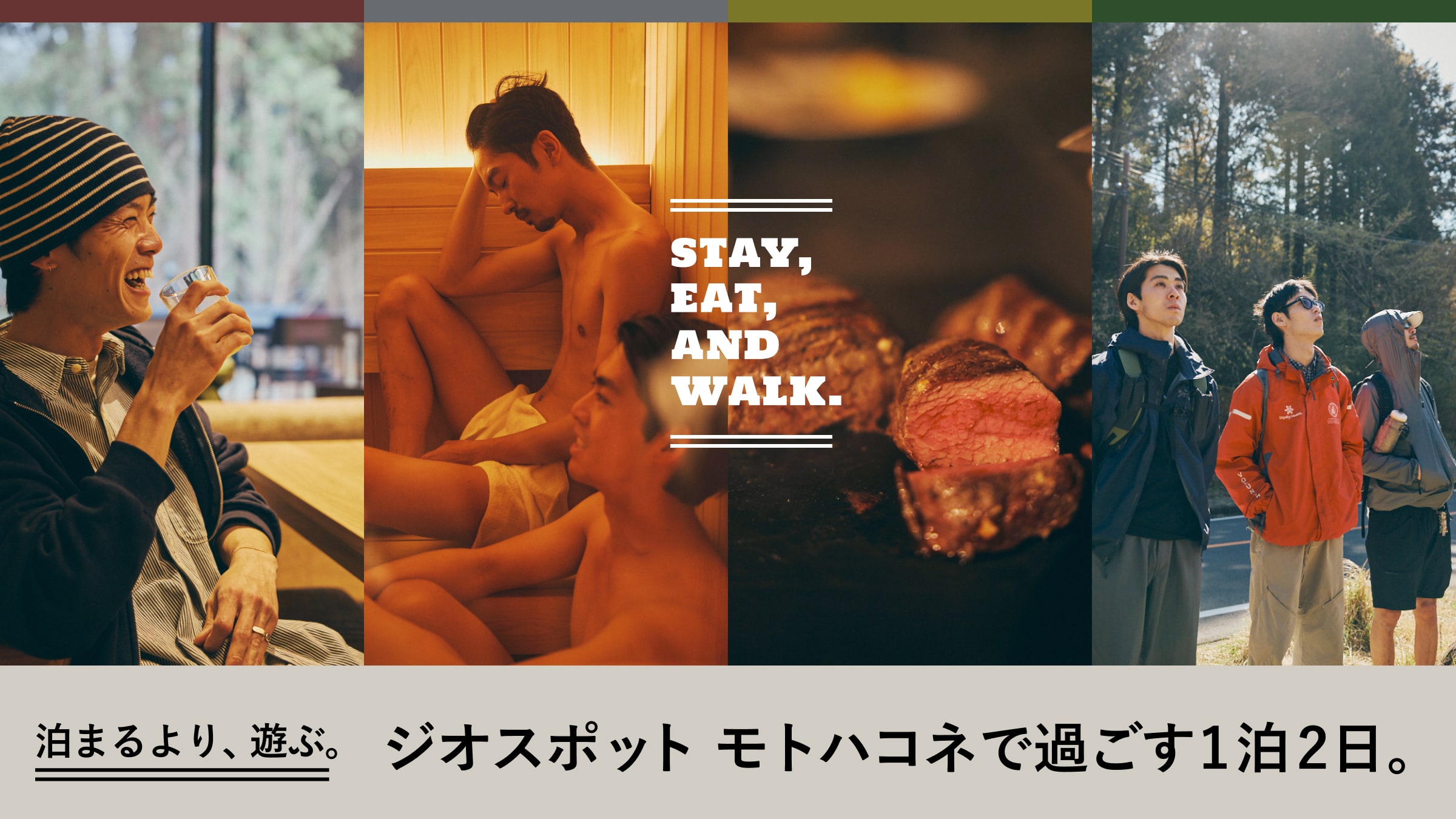
When we arrived at the starting point, our guide, Mr. Kaneko, was already waiting for us. A native of Hakone who still lives there, he is a professional guide and founder of Explore Hakone—a true mountain expert who has guided over 3,000 people across 25 countries.
“Have you ever heard of the Hakone Hachiri? It refers to the route across the Hakone Mountains during the Edo period, stretching about 32 kilometers from Odawara to Mishima. Since one ri is 4 kilometers, eight ri makes up the Hakone Hachiri. Travelers back then would leave Odawara in the morning, have lunch, and arrive in Mishima by evening. That’s quite a distance, isn’t it? Today, we’re going to walk part of that route.” As soon as Mr. Kaneko said this, the three of them looked on with keen interest.
At one of the places we stopped along the way, there was a slope called "Onna-Tobashi-zaka" (Women's Slippery Slope). Apparently, it got its name because the ground would get muddy whenever it rained heavily, and women would often lose their footing and fall. “It rains twice as much in Hakone as it does in Tokyo,” said Kaneko. “That’s why the mud is so bad. There are other steep slopes with names like Sarunobori-zaka (Monkey Slippery Slope) and Oikomi-zaka (Chase Slope)—each name is so vividly descriptive. It’s both funny and not funny. It sounds nice to say that people back then had a great sense of humor, but…”
What Mr. Kaneko took out of his backpack was a pair of “ashinaka”—footwear worn by people back then. A type of straw sandal, they are, as the name suggests, half the length of ordinary straw sandals. Because of this, they fit snugly against the sole of the foot; you could call them the “barefoot shoes” of the Edo period. “As I mentioned earlier, Hakone is a town with a lot of rain. It’s hard to walk when the ground gets muddy, isn’t it? That’s why, during the Edo period, they built this modern-style cobblestone path. While sneakers might be slippery and difficult to walk in, back then people mostly walked in straw sandals, including these ashinaka.”
Mr. Takahashi gave them a try right away. “The straps rub and hurt, and it feels like I’m walking on my toes the whole time. It might be good exercise, but honestly, there’s no way I could walk 32 kilometers in these (laughs). That said, they didn’t slip on the cobblestones, so they were easy to walk in.” Just between us, he switched back to his sneakers before 10 minutes were up.