The feeling of living in an era saturated with photos.
—— I imagine people often say that your work, Mr. Hamamoto, “expands the boundaries of photography.” Is that the result of your exhaustive research into the history of photography?
Hamamoto: If anything, I think I’m completely unfamiliar with it. Some time ago, when I held a traveling exhibition at “Ginza Tsutaya Bookstore,” the person in charge recommended *Against Photography* to me, and I found that the perspective of viewing photography not as something that “accurately explains” reality, but rather as something more ambiguous and uncertain, resonated deeply with my own sensibilities.
Somewhere in the back of my mind, I used to have this image of photography as a medium where professionals frame their work beautifully and describe it with grand words. But I don’t think it’s really that grand. It can tell lies, and it’s just a flimsy piece of paper. There’s a certain unreliable lightness to it—the kind that vanishes if you lose an SD card or a negative. I really love that lightness, which can’t be pinned down by words alone. Precisely because I’m just using a camera as a tool, I can maintain a certain detachment from it. I think it’s a medium that allows me to take responsibility while still feeling liberated.

Nobuno Kuraishi, *A Theory Against Photography* (1999, published by Kawade Shobo Shinsha)
A critique of photography by Mr. Kuraishi, a poet and critic. “When did photography abandon its primal sense of wonder and degenerate into mere illustrations—alibis for predetermined concepts? Photography—a medium that embraces an unmanageable ‘difference in dimensions,’ that is both incomprehensible and immense, yet also possesses an almost excessive transparency…” (from the text)—these words surely resonate with Mr. Hamamoto’s sensibilities.
—— So, it seems that Mr. Hamamoto had that sense of moving “beyond the photograph” instilled in him from the very beginning.
Hamamoto: Since there aren’t many people my age who are into photography, this is just a guess, but I think there’s a part of us that intuitively understands—even without going out of our way to look it up—that photography has “already been done to death” in this day and age. Today’s cameras have high specs and excellent image quality—they surpass the human eye, don’t they? I think it’s only natural to step back from that race for specs for a moment and move toward “trying something unusual” or “doing something only I can do.”
—— Earlier, you mentioned that you used to keep a diary when you were in high school. How mindful are you of language? I’ve heard that you read a lot of printed material on a regular basis.
Hamamoto: The media I trust most are, by far, “words” and “books.” Precisely because I trust them, I am deeply influenced by them. Conversely, I do not unconditionally trust photography as a medium. Words and poetry are things that are carefully crafted and developed over time before they reach the reader’s eyes. Photography, on the other hand, is a medium that begins with an encounter with reality and is established in that very moment. Because of this difference in how they come into being, I approach words and photography as media in completely different ways.
That’s exactly why I’m very conscious of “immediacy” when I’m taking photos. Even if I think, “Oh, I want to take a picture,” that moment is gone before I know it if I hesitate. Just like shutter speed, the subject I want to capture only appears before my eyes for a fleeting moment—a fraction of a second. But I also believe that such moments actually come around more often than you’d think. That’s why I want to be able to react as quickly as possible right then and there.
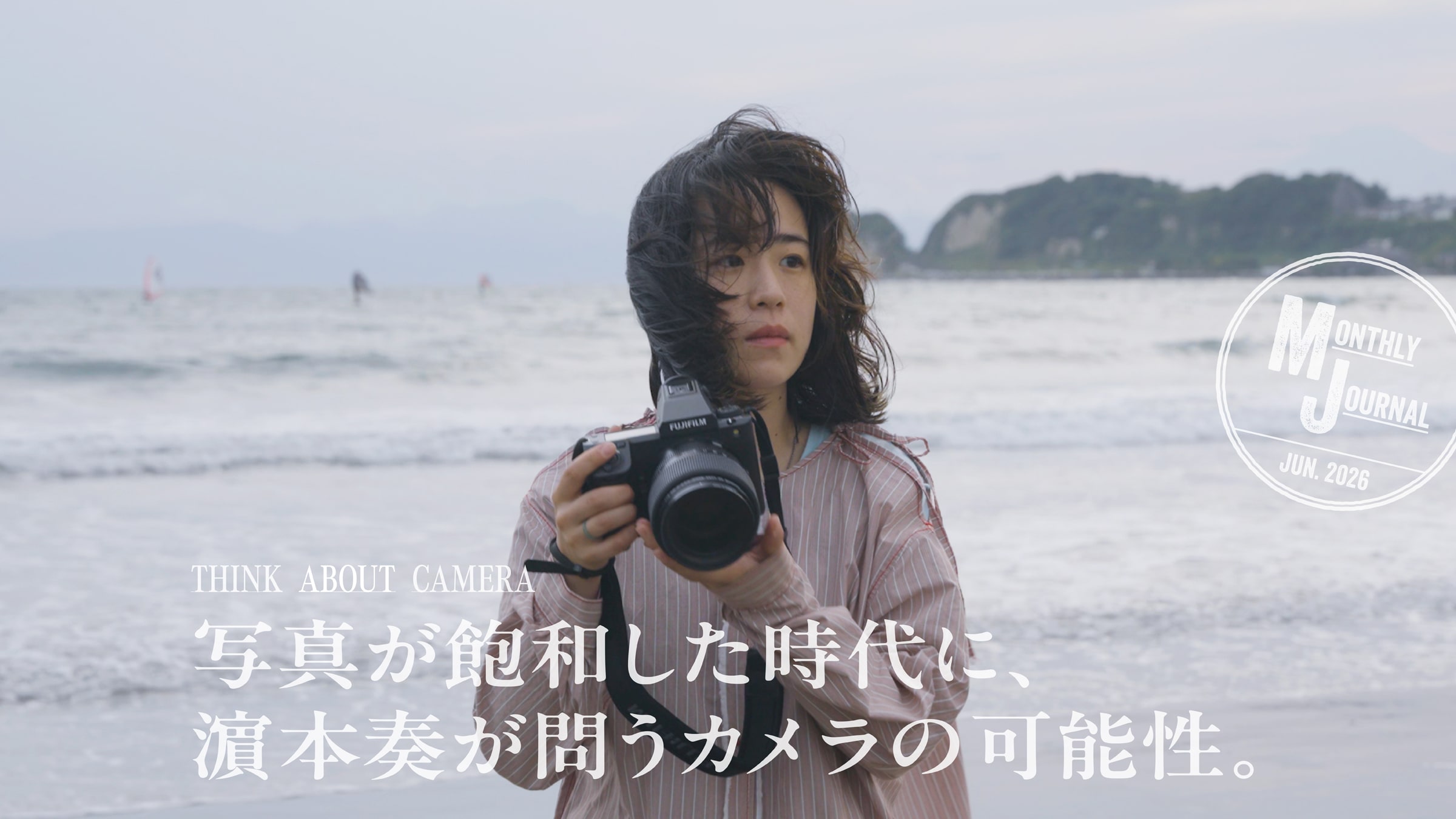
The shock Hamamoto felt when a friend told him that Inamuragasaki in Kamakura—a place he had known for a long time—was actually a military site served as the inspiration for this photo book, “—… (Cho Tan Tan) .”We will soon begin accepting online orders for the reprint of the photo book, with the third printing scheduled for release this August.The photo shoot that day took place at Zaimokuza Beach.
—— The work *—... (Cho Tan Tan)*, which won the “Kimura Ihei Photography Award,” focuses on the “Furyu Special Attack Unit,” a human weapon unit active toward the end of World War II “Furyu Special Attack Unit,” a human weapon used toward the end of World War II. You mentioned that the fact that most official records had been destroyed was one of the motivations behind this project, but is the underlying theme in your work, Mr. Hamamoto, a desire to capture things that are fading away or the small voices that might otherwise be overlooked?
Hamamoto: I’ve always had this consistent desire to preserve as objects things that no one else seems to notice—things I feel I’m the only one who’s discovered. It’s not that I want to show them off; I just hope that 100 years from now, someone might happen to come across that material in a library and think, “Oh, so this is what it was like 100 years ago.” It’s similar to the feeling of putting a letter in a bottle and setting it adrift in the ocean of the future.
People often describe the role of a writer as a “megaphone” or a “vessel that catches up small voices,” but I don’t see myself in such grand terms. However, while data has a lifespan of a few years to a few decades, it’s said that paper lasts 100 years and stone lasts over 1,000 years. For that reason, among others, I don’t place much trust in data. That’s precisely why I’m committed to printing it on paper and preserving it as a physical object.
I often find myself daydreaming. I imagine a world where, someday, humanity has vanished from the face of the Earth, and after I, too, have disappeared, only the photographs I took—as physical objects—remain there, standing alone in my place. I’d like to see that world. I feel like our generation is inevitably bombarded with so much despairing news that it’s all too easy to imagine a post-apocalyptic future after humanity has vanished. Perhaps it’s precisely because we can’t wholeheartedly let go and enjoy the present that this sense of wanting to cast traces of our lives—in the form of physical objects—into the future has become, in a way, a given premise.
QUESTION
Email Interview
Kanade Hamamoto Interviews Takayuki Kobayashi of Flotsam Books: Part 2
Q4. When Mr. Hamamoto’s books are displayed on the shelves at “Flotsam Books,” in what context (such as overseas independent art books or domestic personal photography) do they seem to resonate?
A4. It doesn’t look out of place when placed alongside international photo collections, nor does it look out of place when placed alongside Japanese photo collections, so you could say it fits in anywhere—and yet, at the same time, it doesn’t really fit in anywhere.
Q5. In Hamamoto’s exhibitions, she doesn’t limit herself to any particular medium—she works with photography, text, installations, and more. From your perspective, Mr. Kobayashi, how do you view the relationship between the words she weaves and her photographs? Also, how do you perceive her relationship to photography?
A5. The question is too difficult for me to understand. I’m not sure if this counts as an answer, but I get the feeling that I have a pretty good grasp of what I should be saying and what I should be showing. For example, things that can be explained in words might not need to be expressed through images, three-dimensional forms, or spatial concepts, but I think I have a solid understanding of what I want to convey.
Q6. From her early works to the present, do you see any changes or deepening in her artistic expression? Also, what kind of photographer do you expect her to become in the future?
A6. I feel like his style changes with each piece, so it might still evolve from here on out. I think he’s still in the early stages of his career. I suspect we won’t really understand it until 10 or 20 years have passed. I hope he becomes a photographer who makes a name for himself not just in Japan but around the world. Or, it would be interesting if he gave up photography early on and went into a completely different line of work. I think he’d be an interesting person no matter what he does.
PROFILE
Owner of “Flotsam Books,” a store specializing in art books. He occasionally leaves the store in the hands of Kanade Hamamoto. He has been organizing “ZINE tour,” an event showcasing independent talent, since 2022, and will be holding it nationwide again this year through November.He is also a blogger for Fuinam.
Instagram:@flotsambooks