How to Use a High-Resolution Digital Camera That Exceeds the Human Eye's Capabilities.
—— Could you tell me more about your camera? How do you decide when to use film and when to use digital?
Hamamoto: I sometimes use film for my personal work and digital for my professional work. When it comes to film, I’ve continued to enjoy it just as much as I did back when I first discovered it in high school—that same sense of wonder and tactile sensation I felt when taking photos. Since I don’t use a light meter, the anticipation of not knowing what the photos will look like until they’re developed is part of the excitement. But when it comes to work, that kind of uncertainty would definitely give me a stomachache (laughs), so I sometimes use a digital camera to show clients the photos right on the spot.

My favorite film camera, the Nikon FM3A, is an intermediate-level manual-focus model. In the photo book *midday ghost*, I enjoy the element of chance that comes with photography—for example, by using a broken Fujifilm “Cheki” that I found at a secondhand shop.
—— Do you have a favorite film, Mr. Hamamoto?
Hamamoto: I really love Fujifilm’s “FUJICOLOR 100” and “Fujicolor SUPERIA PREMIUM 400”—which is quite hard to come by these days—are my absolute favorites. Back in the day, there was inexpensive professional-grade film that I used all the time, but compared to that, prices have skyrocketed to nearly ten times what they used to be. Although the “400” was recently brought back, it seems it’s no longer manufactured in Japan but in the U.S., so the color tones have changed slightly.
—— Specifically, what do you like about that film, and what are its strengths?
Hamamoto: In comparison, it’s often said that Kodak film tends to have a “yellowish cast.” On the other hand, Fujifilm gives the impression that blacks come out crisp and well-defined. Even if the colors do shift, I really like that they shift toward a bluish tone—it feels like it blends in perfectly with Japanese landscapes.
—— I hear you’ve used Fujifilm digital cameras before, Mr. Hamamoto. What kind of camera manufacturer is Fujifilm to you?
Hamamoto: When I was a senior in high school, I was set to hold my first solo exhibition, and since I wanted to capture the exhibition space beautifully in digital form, I used my part-time job earnings to buy my first “X Series” mirrorless camera. Back then, I didn’t have any friends around me to ask for advice about digital cameras, so I had to figure everything out on my own, but the deciding factor was “the feel of the controls and the body design, which were similar to those of a film camera.” Even though Fujifilm cameras are equipped with the latest digital technology, they allow for manual operation via dials, and the shape and layout of the buttons are similar to those on analog film cameras, making them feel incredibly familiar to the touch.
And above all, I love the “colors” that captures the most. While digital cameras from different manufacturers render skin tones completely differently, cameras don’t make skin look unnaturally yellow; instead, they capture human skin beautifully, just as it is, with a bluish, translucent quality. I really love those colors—they’re not artificially enhanced in any way.
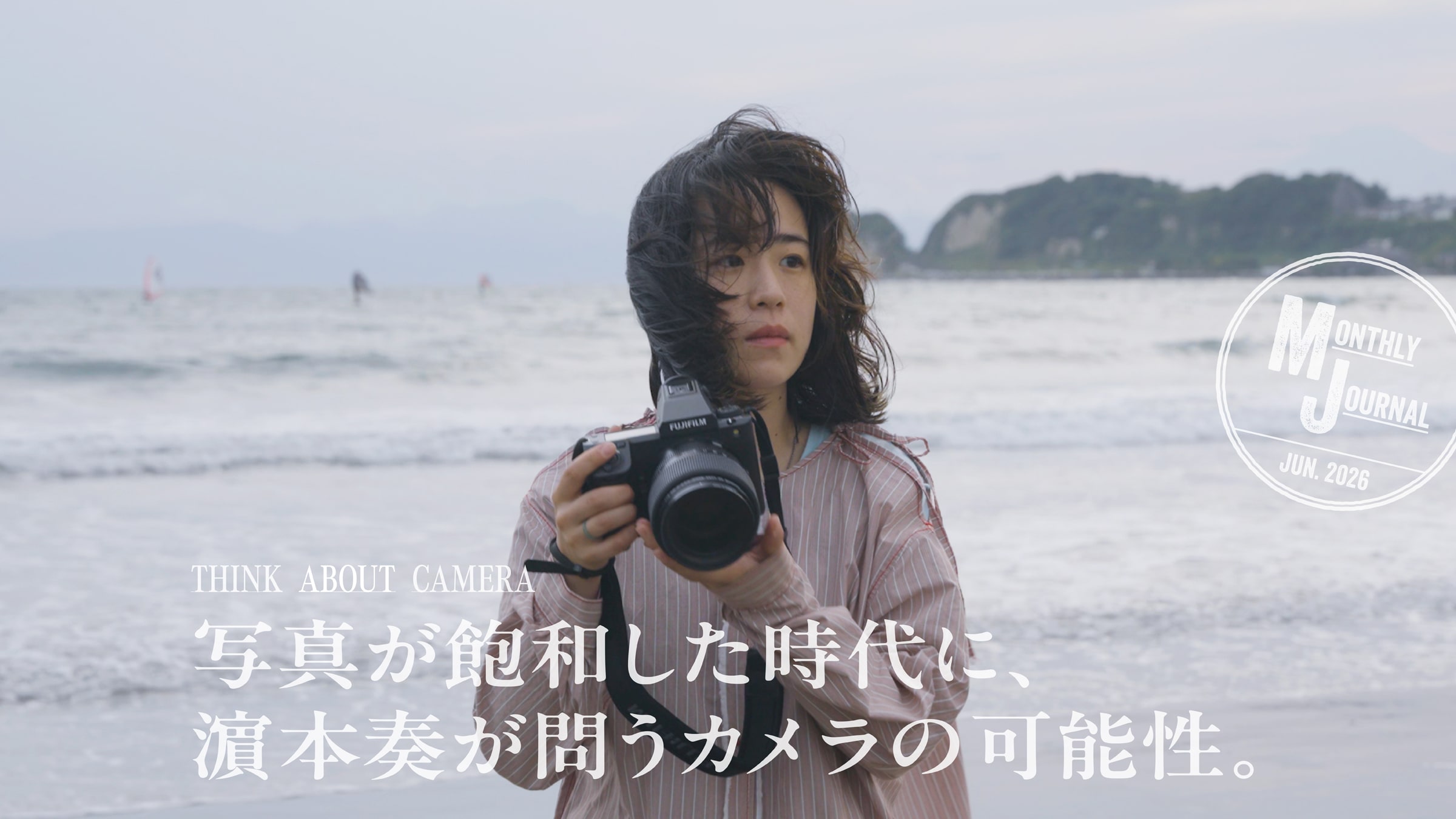
—— Today, you actually got to shoot with Fujifilm’s latest digital medium-format camera, the “GFX100 II.” How did you like it?
Hamamoto: I was overwhelmed by the meticulously detailed imagery—scenes that seemed to “transcend the human eye.” I deliberately narrowed the depth of field to an extremely small range and snapped a shot of a strand of hair; the focus was perfectly sharp on just that single strand, while everything else was beautifully and softly blurred.
I'm glad today's shoot was on the beach. Even through the monitor, I could sense that this camera was capturing every single water droplet and ripple, as well as all the different textures of the sandy shore, without missing a thing.
Photo by Kanade Hamamoto
Photo by Kanade Hamamoto
Photo by Kanade Hamamoto
Photo by Kanade Hamamoto
These four photos were taken by Ms. Hamamoto with the “FUJIFILM GFX100 II.” It was striking to see her marveling at the beauty of the photos—a sunset she had likely seen countless times before—as if she were seeing it for the very first time.
—— I think the unique grain and imperfections of film form the basis of your artistic style, Mr. Hamamoto. Now that you have a digital camera boasting such “ultra-high resolution,” what kind of photos would you like to take in the future?
Hamamoto: I really wanted to try taking portraits with this camera. When I look at the manufacturer’s sample photos, there are, as expected, a lot of majestic landscape shots of waterfalls and mountains, but I’d like to deliberately use this camera to take pictures of my grandmother and others (lol). I think I might be able to capture unique, full-of-character portraits that really bring out the texture of her deep wrinkles.
It’s certainly interesting to capture every detail in a location that’s naturally rich in visual information right from the start, but I’d also like to try photographing people in a carefully crafted setting—such as an indoor studio with a deliberately minimalist background—where there’s no visual clutter. I’m curious to see what would happen if I used this camera to capture every last detail—from the way light enters the human eye to a single eyelash, and even the finest wrinkles on the skin—pushing the camera’s capabilities to the absolute limit.
CAMERA
FUJIFILM GFX100 II
A mirrorless camera equipped with a large-format sensor featuring approximately 102 million pixels. Powered by the latest “X-Processor 5,” it delivers AI subject recognition AF and high-speed continuous shooting at up to 8.0 frames per second. Furthermore, it supports powerful in-body image stabilization of up to 8 stops and 8K/30p video recording, making it a flagship model that boasts overwhelming image quality for both stills and video. Although it is a high-resolution medium-format camera, the body alone weighs approximately 867g, ensuring high portability.